
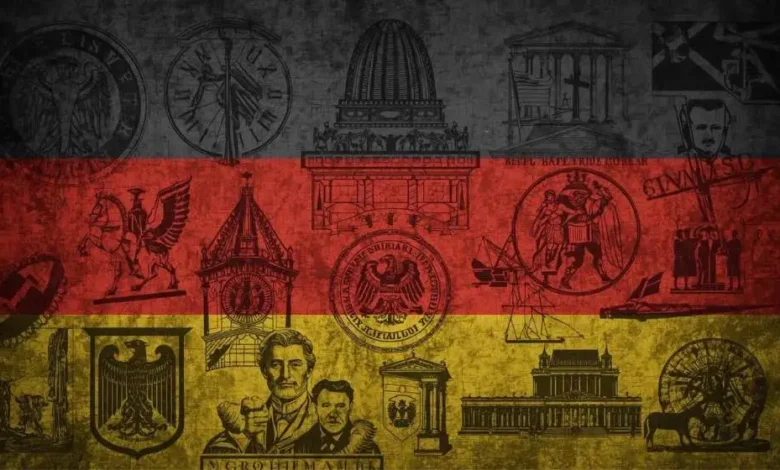
Germany, located in the heart of Europe, has a history that stretches over two millennia, marked by significant cultural, political, and social developments. The German people have witnessed dramatic transformations, from the early days of the Germanic tribes to the rise and fall of empires, the horrors of war, and its eventual emergence as a democratic powerhouse in the modern world. Germany’s journey through history is marked by triumph, tragedy, and resilience, and understanding it offers profound insights into both European and global affairs.
This article provides a detailed look at the key moments and figures that have shaped Germany’s past, from its early days as a collection of fragmented tribes to its reunification and rise as a modern power in the 21st century. It covers the rise of Prussia, the Holy Roman Empire, the Nazis, World War II, and the post-war period, including the leadership of Adolf Hitler and the Nazi regime.
The Early Germanic Tribes: Origins of Germany
The history of what is now modern-day Germany begins with the Germanic tribes, who inhabited central Europe long before the formation of the German state.
These tribes, such as the Goths, Vandals, and Franks, played a major role in the collapse of the Western Roman Empire. The earliest Germanic peoples were known for their warrior culture and lived in a loose confederation of tribes that were constantly in conflict with neighboring tribes and the Roman Empire.
The most famous early event in German history was the Battle of the Teutoburg Forest in 9 AD, where a coalition of Germanic tribes, led by Arminius, ambushed and destroyed three Roman legions. This battle was pivotal because it halted Roman expansion into Germania and solidified the Germanic peoples’ resistance against Roman control.
The Roman Impact on German Territories
Though the Germanic tribes successfully resisted Roman domination, parts of the region did fall under Roman influence. The Romans controlled areas in the south of present-day Germany, and Roman culture and architecture left a lasting legacy. Key Roman-built structures, such as Hadrian’s Wall in Britain, reflect the Romans’ strategic concerns with their northern borders.
Romanization introduced important changes to the tribal cultures of central Europe. The Romans brought with them advanced military techniques, infrastructure such as roads, and the early foundations of trade and urbanization.
However, by the early 5th century, the Western Roman Empire began to collapse, leading to the gradual retreat of Roman power and the rise of the Germanic tribes.
The Holy Roman Empire: The Fragmented German State
The history of Germany during the Middle Ages is primarily defined by the Holy Roman Empire, a collection of territories that spanned central Europe and was established in 800 AD by Charlemagne, King of the Franks.
Though not a unified nation-state as we understand it today, the Holy Roman Empire was a loose confederation of states, duchies, and cities that were under the nominal rule of an emperor.
The Holy Roman Empire, in which modern Germany was a major player, was a complex system of governance, marked by decentralized authority.
The Emperor of the Holy Roman Empire did not have direct control over all territories; instead, various local rulers and princes held substantial power, often leading to conflicts and fragmentation. The Empire’s decentralized structure prevented the formation of a unified German state, leaving it politically fragmented for centuries.
The Rise of the Habsburg Dynasty
In the 15th century, the Habsburg family rose to prominence as emperors of the Holy Roman Empire, holding the imperial title from 1438 to 1806. Under the Habsburgs, the Holy Roman Empire experienced periods of consolidation and centralization, but it never achieved full unity.
Throughout the empire’s long history, Germany was often a battleground for the power struggles between various European nations.
The Rise of Prussia: Foundations of Modern Germany
In the 17th and 18th centuries, the Kingdom of Prussia emerged as a major power within the Holy Roman Empire. Located in the northeastern part of modern Germany, Prussia grew into a military powerhouse under the leadership of Frederick the Great in the 18th century. Prussia’s rise was marked by its efficient bureaucracy, military innovations, and centralized authority.
By the early 19th century, the idea of German unification began to take hold. German-speaking people across central Europe began to see themselves as a unified cultural and linguistic group. However, they were still divided among numerous independent states.
The Napoleonic Wars, which swept across Europe in the early 19th century, also played a role in pushing the idea of a unified Germany.
The German Confederation and the Road to Unification
Following the defeat of Napoleon in 1815, the German Confederation was established as a loose association of 39 independent German-speaking states. This confederation included both small duchies and large kingdoms such as Prussia and Austria.
Though these states were united by language and culture, they remained politically fragmented and lacked the central authority needed for full unification.
The movement for German unification gained momentum in the mid-19th century, particularly after the failed revolutions of 1848, which sought to establish a unified and democratic German state.
The failure of these revolutions led to a new approach, with Otto von Bismarck, the Prime Minister of Prussia, taking the lead in orchestrating German unification through diplomacy and war.
The Wars of German Unification
Bismarck’s strategy for unification involved a series of military conflicts. In 1864, Prussia allied with Austria to defeat Denmark in the Second Schleswig War, gaining control of the duchies of Schleswig and Holstein. The next year, Prussia and Austria fought the Austro-Prussian War, resulting in the exclusion of Austria from German affairs and solidifying Prussia’s dominance in the north.
The final step toward unification came in 1870, when Bismarck engineered the Franco-Prussian War. By provoking France into declaring war, Bismarck united the northern German states under Prussian leadership and rallied the southern German states to join the new German Empire. In 1871, the German Empire was proclaimed in the Hall of Mirrors at Versailles, officially uniting Germany as a powerful nation-state.
The German Empire: Power and Prestige
Under the leadership of Kaiser Wilhelm I, Germany rapidly became one of the world’s most industrialized and militarized nations. The German Empire was a major player in European politics, and its military prowess, particularly under the leadership of Bismarck, made it a dominant force in Europe. The Empire’s growth was also marked by economic prosperity and technological innovation.
However, Germany’s aggressive policies in foreign relations and military expansion created tensions with other European powers, especially France and the United Kingdom. The complex system of alliances and rivalries in Europe eventually led to the outbreak of World War I in 1914.
World War I: The Downfall of the German Empire
World War I was a catastrophic event for Germany and the world. The war, fought from 1914 to 1918, involved most of Europe and resulted in unprecedented casualties and destruction. Germany, part of the Central Powers, fought against the Allied Powers, which included Britain, France, and Russia.
After years of brutal trench warfare, Germany was forced to surrender in November 1918. The Treaty of Versailles, signed in 1919, placed full blame for the war on Germany and imposed harsh penalties, including massive reparations. The treaty humiliated Germany and led to severe economic hardship, contributing to political instability.
The Weimar Republic and the Rise of Hitler
Following the collapse of the German Empire, the Weimar Republic was established in 1919 as Germany’s first democratic government. However, the Weimar Republic was plagued by economic instability, including the hyperinflation crisis of 1923, and political extremism from both the far left and far right.
The most infamous figure to rise from this chaos was Adolf Hitler, who led the Nazi Party. Hitler promised to restore Germany’s power and prestige and to undo the humiliating terms of the Treaty of Versailles. Through a combination of charisma, propaganda, and political maneuvering, Hitler became Chancellor in 1933.
The Nazi Regime: Hitler’s Rise to Power
Once in power, Hitler quickly moved to consolidate his authority. The Reichstag Fire in 1933 allowed Hitler to pass emergency laws that suspended civil liberties and gave him dictatorial powers. The Nazi regime’s policies of aggression, expansionism, and anti-Semitism would have disastrous consequences for Germany and the world.
Hitler’s goals included the creation of a Greater Germany and the establishment of a racially pure Aryan state. These ambitions led to the outbreak of World War II in 1939, as Germany invaded Poland. The war, which lasted from 1939 to 1945, resulted in the deaths of millions and the destruction of much of Europe.
The Holocaust: The Genocide of the Jews
One of the darkest aspects of Hitler’s rule was the Holocaust. The Nazi regime implemented a policy of systematic genocide that led to the deaths of six million Jews, as well as millions of other people, including Romani, disabled individuals, and political dissidents. The Holocaust remains one of the most horrific events in human history.
World War II: Germany’s Defeat and Aftermath
Germany’s early victories in World War II, including the rapid conquest of France in 1940, were followed by setbacks, as the Allies launched a counteroffensive. In 1944, the Allies launched D-Day, a successful invasion of Nazi-occupied France. By 1945, Soviet and Allied forces had surrounded Berlin, and Hitler committed suicide in his bunker in April 1945.
Germany’s unconditional surrender in May 1945 marked the end of the war in Europe. The country was left in ruins, its cities destroyed and its economy shattered.
The Division of Germany: Cold War Politics
After World War II, Germany was divided into four occupation zones controlled by the United States, the Soviet Union, the United Kingdom, and France. This division laid the foundation for the Cold War, as the Western Allies and the Soviet Union turned Germany into a battleground for ideological and political supremacy.
In 1949, Germany was officially split into two countries: the Federal Republic of Germany (West Germany) and the German Democratic Republic (East Germany). The Berlin Wall, erected in 1961, symbolized the division of Germany and the ideological conflict between East and West.
Reunification of Germany: A New Chapter
The fall of the Berlin Wall in 1989 marked the beginning of the end of the Cold War and the reunification of Germany. In 1990, after decades of division, East and West Germany were officially reunified into a single, democratic nation. The process of reunification, however, was not without challenges, as East Germany’s economy was far less developed than that of the West.
Today, Germany is a unified, democratic country, one of the most powerful economies in Europe, and a key player on the global stage. It is a member of the European Union, NATO, and the United Nations, and it plays an essential role in shaping European and global politics.
Conclusion: Germany’s Complex Legacy
Germany’s history is a testament to its resilience and capacity for reinvention. From its roots as fragmented tribes to its rise as a powerful empire, through its darkest moments under Hitler’s regime and its eventual reunification, Germany’s past has been marked by remarkable shifts in power, culture, and identity.
The story of Germany is one of overcoming adversity and learning from its past, making it an essential piece of the European and global historical landscape. Today, Germany is a beacon of democracy, economic strength, and international cooperation, shaping the future while never forgetting its tumultuous past.
FOR MORE INTERESTED BLOGS PLAESE VISIT OUR WEBSITE