




Getting a business loan in the USA is not complicated — but it is process-driven. Lenders follow a specific checklist, and if you show up without the right documents, the right credit profile, or the right loan type, you will get rejected even if your business is profitable.
In 2026, over $36.5 billion in SBA 7(a) and 504 loans have already been approved across 65,000 applications — but thousands more are denied every year for avoidable reasons.
This guide covers everything: which loan type fits your situation, what lenders actually look for, how to apply step by step, where to find the best rates, and the mistakes that kill applications before they reach a decision-maker.
What Types of Business Loans Are Available in the USA?
The right loan depends on your purpose, credit profile, and how quickly you need funds. The USA has more business lending options than most countries — but choosing the wrong product is one of the most expensive mistakes you can make.
Here is a breakdown of the major loan types available today:
SBA Loans
SBA loans are partially guaranteed by the U.S. Small Business Administration, which means the government covers a portion of the lender’s risk if you default. This government backing allows lenders to approve borrowers who might not qualify for conventional financing alone, with lower down payments and competitive interest rates.
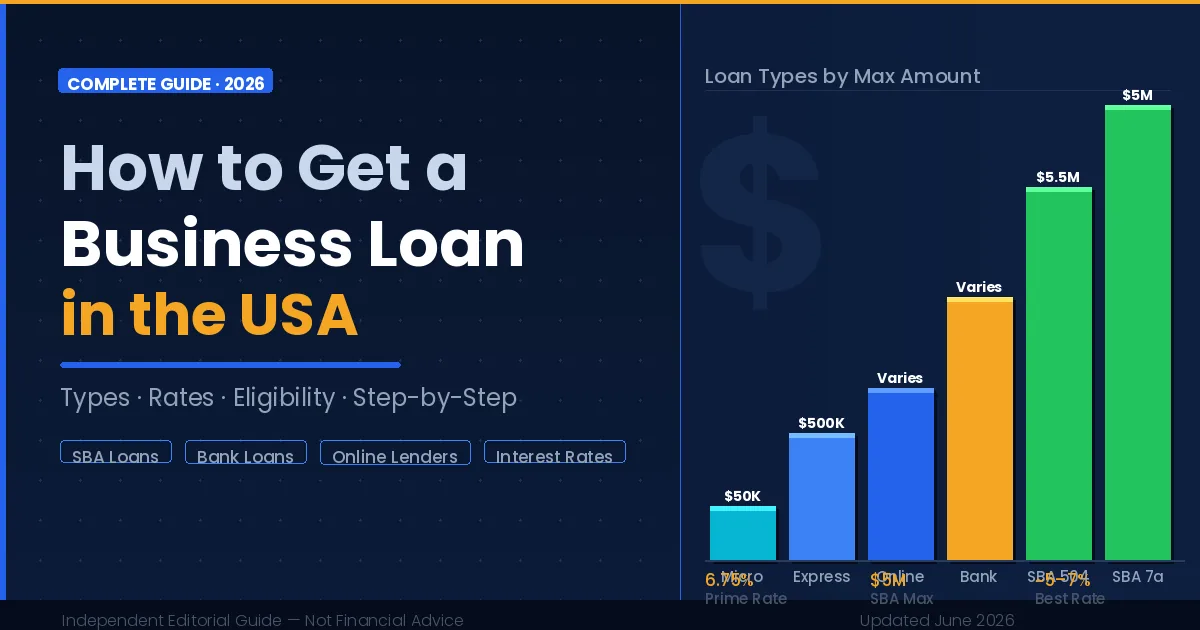
SBA 7(a) Loan — The most widely used program. Most 7(a) loans have a maximum loan amount of $5 million. You can use the funds for working capital, equipment, real estate, debt refinancing, and business acquisitions. With the current prime rate at 6.75% as of May 2026, SBA 7(a) fixed rates range between 9.75% and 14.75% depending on your loan terms.
SBA 504 Loan — Designed for major fixed assets: real estate and heavy equipment. Interest rates for SBA 504 loans are tied to the 10-year U.S. Treasury note and typically range from about 5% to 7%. These are fixed-rate loans, which makes long-term budgeting predictable.
SBA Microloan — SBA Microloans max out at $50,000 and come from intermediary lenders, usually non-profit community lenders. They carry a maximum repayment period of seven years. This is ideal for startups and very small businesses that need modest capital.
SBA Express Loan — Faster approvals, but capped at $500,000 in total funding with the same rate structure as the 7(a) program.
Traditional Bank Term Loans
Banks offer straightforward lump-sum loans repaid over a fixed term. Bank term loans typically run between 8% and 17.25% in interest and come with strict eligibility requirements. They work best for established businesses with two or more years of financial history, strong revenue, and good credit. If you qualify, bank loans usually offer the lowest rates outside of SBA products.
Business Line of Credit
A line of credit gives you access to a revolving pool of funds — you draw what you need and only pay interest on what you use. This is well-suited for managing cash flow gaps, seasonal expenses, or unexpected costs. It is not ideal for large capital purchases.
Equipment Financing
If you are buying machinery, vehicles, or technology, equipment financing lets the equipment itself serve as collateral. This makes approval easier and rates more competitive, often ranging from 8% to 20% depending on the equipment and your credit.
Invoice Financing and Factoring
If your business has outstanding invoices but needs cash immediately, you can borrow against those unpaid bills (financing) or sell them at a discount to a third party (factoring). Rates vary widely. This option is most useful for B2B businesses with slow-paying clients.
Merchant Cash Advance (MCA)
An MCA provides a lump sum in exchange for a percentage of your future credit card sales. Approval is fast and credit requirements are low — but the cost is extremely high, often equivalent to a triple-digit APR. Use this only as a last resort. Also note: the SBA no longer allows the use of an SBA loan to refinance merchant cash advances.
Online and Alternative Lenders
Online lenders like Fundbox, Bluevine, and OnDeck offer faster approvals and more flexible eligibility. Even at the higher end, SBA loan rates are considerably lower than most online business loans, which can range from 14% to 99%. They are a viable option when speed matters more than cost, or when you do not yet qualify for traditional financing.
Business Loan Comparison Table (2026)
| Loan Type | Max Amount | Rate Range | Approval Time | Best For |
|---|---|---|---|---|
| SBA 7(a) | $5 million | 9.75% – 14.75% | 30–90 days | Working capital, expansion |
| SBA 504 | $5.5 million | 5% – 7% (fixed) | 60–90 days | Real estate, equipment |
| SBA Microloan | $50,000 | 8% – 13% | 30–60 days | Startups, micro-businesses |
| SBA Express | $500,000 | 9.75% – 14.75% | Under 36 hours | Fast SBA access |
| Bank Term Loan | Varies | 8% – 17.25% | 2–8 weeks | Established businesses |
| Online Lender | Varies | 14% – 99%+ | 1–5 days | Speed, weaker credit |
| Equipment Financing | Varies | 8% – 20% | Days to weeks | Equipment purchases |
| Merchant Cash Advance | Varies | Very high (MCA factor) | 24–48 hours | Last resort only |
Rates based on a prime rate of 6.75% as of May 2026. Verify current rates before applying.
What Do Lenders Actually Look For?
Lenders evaluate five core factors before approving any business loan. Understanding these is the difference between a strong application and an automatic rejection.
1. Credit Score
Your personal credit score is the first thing most lenders check, especially for small businesses.
- Traditional banks: 680+ personal credit score is typically required.
- SBA loans: Generally require a minimum around 620–640. Very poor credit, typically below 620, makes approval unlikely.
- Online lenders: Can work with scores as low as 525, though lower scores usually mean higher borrowing costs.
Your business credit score (Dun & Bradstreet, Experian Business, FICO SBSS) also matters, particularly for SBA applications. Start building it early by opening business credit accounts and paying them on time.
2. Time in Business
Most lenders want to see at least two years of operating history. This shows stability and gives them financial data to evaluate. SBA lenders apply the same standard in most cases — though SBA’s 7(a) program remains available to startups in some cases, but lenders often need stronger documentation and projections. As of December 22, 2025, almost 17% of 7(a) loan funds were made to startups.
3. Annual Revenue
Lenders want to know your business generates enough income to cover the loan payment. Most traditional lenders look for at least $100,000 in annual revenue, though requirements vary. Online lenders are more flexible, sometimes accepting as little as $50,000 per year in revenue.
The key metric is your debt service coverage ratio (DSCR) — your net operating income divided by your total debt payments. A DSCR above 1.25 is generally what lenders consider acceptable.
4. Collateral
Collateral is an asset a lender can seize if you default. For SBA loans, collateral requirements depend on the loan size and type. SBA CDC/504 loans require collateral — typically the financed assets — along with personal guarantees from the business owners.
For 7(a) loans, collateral is required when available but is not a disqualifying factor on its own. What is universal: any business owner who owns at least 20% of the business must provide an unlimited personal guarantee, meaning a lender can go after your personal assets if you default on the loan.
5. Business Plan and Financial Statements
Lenders want to understand your business model, how you will use the funds, and how you will repay the loan. For SBA loans, this includes a detailed business plan, projected financials, and a clear explanation of the loan purpose. For startup borrowers especially, a well-prepared business plan can compensate for a limited financial track record.
How to Apply for a Business Loan: Step by Step
Applying for a business loan is a methodical process. Rushing it is one of the most common reasons applications stall or fail. Follow these steps to give yourself the best chance of approval.
Step 1: Know your credit score before any lender does. Pull your personal credit report from AnnualCreditReport.com and check your business credit from Dun & Bradstreet or Experian Business. Fix any errors — incorrect late payments or inaccurate balances can shave dozens of points off your score unnecessarily.
Step 2: Define exactly how much you need and why. Vague loan requests raise red flags. Lenders want specifics: “I need $120,000 to purchase two delivery trucks” is far more compelling than “I need capital for growth.” Calculate the exact amount with room for contingencies, but do not over-borrow — your repayment capacity matters.
Step 3: Choose the right loan type. Use the comparison table above. If you have time and solid credit, SBA loans offer the best rates. If you need funds in days, an online lender makes more sense. Matching the loan type to your actual situation saves weeks of time and dramatically improves your approval odds.
Step 4: Research and compare lenders. Do not apply to the first lender you find. Compare at least three options. Choosing the right SBA lender can save you money, boost your odds of approval and get you funding more quickly. Picking a less-experienced lender can massively slow the process down. For SBA loans, look for Preferred Lender Program (PLP) lenders — they have authority to approve loans without additional SBA review, which cuts weeks off the process.
Step 5: Gather your documents in advance. Missing documents are the #1 reason applications stall. Prepare:
- Last 2–3 years of business tax returns
- Last 2–3 years of personal tax returns (for all owners with 20%+ stake)
- Year-to-date profit and loss statement
- Balance sheet
- 3–6 months of business bank statements
- Business licenses and legal documents (articles of incorporation, operating agreements)
- Government-issued ID for all owners
- Business plan (especially for startups or SBA loans)
- Accounts receivable and payable aging reports
- List of business debts (existing loans, leases)
- For SBA 7(a): SBA Form 1919 (Borrower Information Form) is required for all 7(a) loans.
Step 6: Submit your application carefully. Review every field before submitting. Inconsistencies between your tax returns and your stated revenue are an automatic red flag. If you are not sure how to answer a question, call the lender directly — they want to help you apply correctly.
Step 7: Respond to lender requests immediately. After submitting, lenders will often request additional documents or clarifications. Delays on your end extend the timeline significantly. Treat every lender request as urgent — even if the approval timeline is 60 days, slow document responses can stretch it to 90 or more.
Step 8: Review the loan offer carefully before signing. When an offer arrives, do not sign immediately out of excitement. Check the APR (not just the interest rate), origination fees, prepayment penalties, personal guarantee terms, and collateral requirements. Compare the total cost of borrowing — not just the monthly payment.
Banks vs. SBA vs. Online Lenders — Which One Should You Choose?
Each lending channel has a different risk tolerance, process, and cost. Here is how to think about the decision:
Choose a traditional bank if: You have 2+ years in business, 680+ credit, solid revenue, and collateral. Banks offer the most competitive rates for borrowers who qualify, and an existing banking relationship can speed up the process.
Choose an SBA lender if: You need favorable terms but cannot qualify for a conventional bank loan. SBA loans tend to be more affordable and have more favorable terms — longer repayment periods and lower credit score requirements than other business loans — because they are guaranteed by the federal government. The tradeoff is time: SBA loans take 30–90 days depending on the loan type.
Choose an online lender if: You need capital quickly, have been in business less than two years, or have a credit score under 650. You will pay more — sometimes significantly more — but the speed and accessibility can justify the cost when you have an urgent opportunity.
Important 2026 update: As of March 1, 2026, SBA loans now require that all business owners be U.S. citizens or nationals. If your business has non-citizen owners, this affects SBA eligibility.
What Mistakes Kill Business Loan Applications?
After reviewing how applications succeed, here are the patterns that cause them to fail — and how to avoid them.
Applying with unreviewed credit. Many business owners discover credit problems only after a lender pulls their report. By then, the inquiry has already affected their score. Pull your own credit first, dispute errors, and wait for any disputes to resolve before applying.
Borrowing without a clear purpose. “General working capital” is a legitimate loan purpose, but it requires more supporting documentation than a specific use. Lenders need confidence that their money will generate a return. Be specific.
Applying to too many lenders at once. Multiple hard credit inquiries in a short window can lower your score by several points and signal financial desperation to lenders. Research first, then apply strategically to the most likely matches.
Ignoring your debt service coverage ratio. Even if your revenue looks good on paper, if your existing debt obligations leave little room for a new payment, lenders will decline. Calculate your DSCR before applying: take your net operating income and divide it by your total annual debt payments. Anything below 1.0 means you cannot cover your debts from operations.
Submitting incomplete or inconsistent documents. Discrepancies between your tax returns, bank statements, and stated financials raise immediate red flags. A lender who finds inconsistencies — even innocent ones — will often reject the application rather than investigate.
Choosing the wrong loan type for the use case. Using a short-term online loan to fund a long-term renovation creates a cash flow mismatch. Matching loan term to asset life is a basic principle many first-time borrowers overlook.
Underestimating the personal guarantee. Personal guarantees are standard in small business lending. Before signing, understand what it means: if the business defaults, your personal assets — savings, home equity, investments — can be used to satisfy the debt.
Frequently Asked Questions About Business Loans in the USA
What credit score do I need to get a business loan in the USA?
It depends on the lender. Traditional banks generally require a 680+ personal credit score. SBA loans are accessible to borrowers with scores around 620–640, though stronger credit improves your terms. Online lenders can work with scores as low as 525, but at significantly higher interest rates. Your business credit score also plays a role in the decision.
Can a startup get a business loan in the USA?
Yes, but it is harder. Most lenders prefer two or more years of operating history. SBA Microloans and some SBA 7(a) products are accessible to startups, but you will need a strong business plan, personal credit above 680, and sometimes collateral or personal investment in the business. Alternative lenders also serve early-stage businesses, though at higher rates.
How long does it take to get approved for a business loan?
It varies widely by loan type. Online lenders can approve and fund within 24–72 hours. Bank term loans typically take 2–8 weeks. SBA loans range from 30 to 90 days, depending on the program and lender. Using an SBA Preferred Lender can shorten the SBA timeline significantly since they do not need additional SBA review before approval.
What documents do I need for a business loan application?
Core documents include: personal and business tax returns for the last 2–3 years, recent bank statements (3–6 months), profit and loss statement, balance sheet, business licenses, and government-issued ID. SBA loans require additional forms like SBA Form 1919. Having these organized before applying speeds up the process considerably.
How much can I borrow for a business loan?
The maximum depends on the loan type and your qualifications. SBA 7(a) loans go up to $5 million; SBA 504 loans up to $5.5 million for manufacturers. Online lenders and bank loans vary by lender. In practice, your approved amount is constrained by your revenue, existing debt, credit profile, and ability to repay — not just the program maximum.
Do I need collateral to get a business loan?
Not always. Online lenders typically do not require collateral. SBA 7(a) loans require collateral when available but will not decline an otherwise strong application solely due to insufficient collateral. SBA 504 loans use the financed asset as collateral by design. However, virtually all small business loans — regardless of collateral — require a personal guarantee from owners with 20% or more ownership.
What is the easiest type of business loan to get?
Merchant cash advances and short-term online loans have the lowest approval barriers, but they carry the highest costs. If “easy to get” matters most, an online lender like Fundbox or Bluevine — with minimum credit requirements around 525–600 — is more accessible than a bank or SBA lender. The tradeoff is always cost: easier approval means higher rates.
Are SBA loan rates going up or down in 2026?
SBA loan rates have held steady since the Federal Reserve last cut rates in December 2025, and are the lowest they have been since 2022 — making them one of the most affordable borrowing options right now. Whether rates fall further depends on Federal Reserve policy. Variable-rate SBA loans will adjust if the prime rate changes.
Conclusion: Your Next Step Toward Getting Funded
Getting a business loan in the USA is about preparation. Lenders are not gatekeepers — they are partners looking for evidence that lending to you is a sound decision. When you show up with clean financial records, a clear purpose for the funds, and the right loan type matched to your situation, approval becomes the expected outcome rather than a hopeful guess.
Start with your credit profile today. Know your numbers — DSCR, annual revenue, existing debt load — before you walk into any lender conversation. If you are aiming for an SBA loan, find a Preferred Lender Program bank in your area and ask about pre-qualification. If you need funds in the next week, an online lender comparison platform like Lendio or Nav can show you multiple offers with a single application.
The funding exists. The process is predictable. The only thing standing between you and a business loan is knowing exactly what to bring to the table — and now you do.
Explore fresh content that brings value—start reading and charge ahead with quiet certainty.