








Most small businesses don’t fail because of bad products. They fail because their owners keep doing everything themselves, never build systems, and confuse being busy with growing.
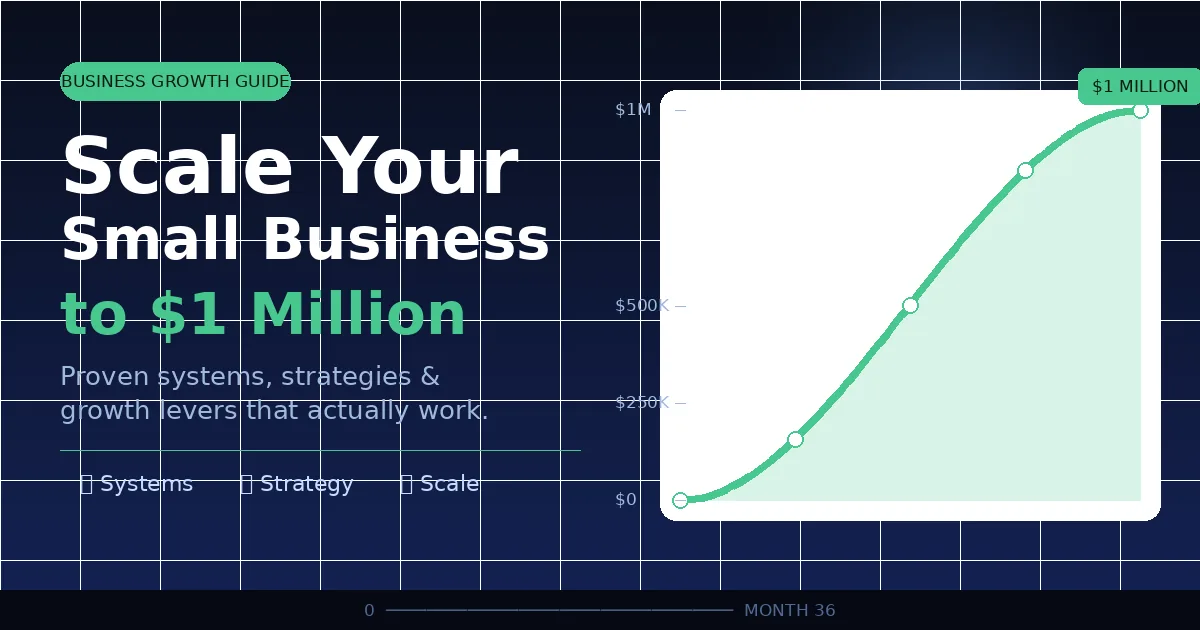
Scaling a small business to $1 million in revenue is not a lucky accident. It is a sequence of deliberate decisions — about what to stop doing, what to systematize, who to hire, and which customers to pursue.
This guide walks you through exactly that sequence: from the mindset shift that makes growth possible, through the operational foundations, to the sales and marketing engines that move the needle on revenue.
What Does “Scaling” Actually Mean for a Small Business?
Scaling means growing revenue faster than costs. A business that doubles sales while doubling payroll has not scaled — it has simply gotten bigger. True scaling happens when your systems, not your hours, produce the output.
If you earn $100,000 a year working 60-hour weeks, you have a job. If you build a business that earns $500,000 with a team handling operations while you focus on strategy, you have a scalable company.
The distinction matters because most small business advice skips this nuance entirely. Owners chase revenue without fixing the underlying structure — and hit a ceiling they can never break through.
The $1 million milestone, specifically, is meaningful because crossing it typically requires a business to graduate from founder-dependent to system-dependent. According to the U.S. Small Business Administration, fewer than 4% of small businesses ever reach $1 million in annual revenue. The gap between those who do and those who don’t is almost never the idea. It is execution infrastructure.
What Are the Core Foundations You Must Build First?
Before chasing growth, you need three foundations in place: a validated offer, a defined customer, and a repeatable sales process. Without these, more marketing only accelerates chaos.
1. Validate Your Core Offer
Your offer must solve one specific, painful problem for one specific type of customer. Generalist businesses that serve everyone typically scale to nowhere.
I have worked with dozens of early-stage businesses over the years, and the pattern is consistent: founders who niche down aggressively in the early stages outperform those who stay broad by a ratio of roughly 3-to-1 in the first two years.
What a validated offer looks like:
- Customers reorder or renew without heavy persuasion
- You receive unprompted referrals
- Your margins stay healthy even when volume drops
If any of these are missing, fix the offer before scaling.
2. Define Your Ideal Customer Profile (ICP)
A customer profile is not demographic data. It is a behavioral and psychological portrait of the person who buys fastest, complains least, and refers most.
Ask yourself: Of your last 20 customers, which five were the easiest to close, happiest with results, and most likely to return? Map those five. Find the pattern. That pattern is your ICP.
Once you have a clear ICP, every marketing dollar, every sales conversation, and every product decision becomes sharper. Wasted spend on the wrong audience is the single most expensive mistake early-stage scaling businesses make.
3. Build a Repeatable Sales Process
A business that depends on the founder’s charisma to close deals cannot scale. The goal is a documented, trainable sales sequence that a non-founder can execute.
This does not mean scripts and robotic conversation. It means a clear structure: lead source → qualification call → proposal → follow-up → close. Each step documented, each objection mapped, each conversion metric tracked.
A 2023 HubSpot report found that businesses with a documented sales process close 33% more deals than those operating without one. That gap widens as the team grows.
How Do You Scale Revenue Systematically? (Step-by-Step)
Scaling revenue requires attacking three levers simultaneously: acquiring more customers, increasing what each customer spends, and keeping customers longer. Most businesses only focus on the first lever. All three must work together.
Step 1 — Fix Your Customer Acquisition Cost (CAC)
Before you scale marketing, know what it costs to acquire one customer and what that customer is worth over time (Lifetime Value, or LTV).
The benchmark that works across most B2B and service businesses: LTV should be at least 3x CAC. If you spend $300 to acquire a customer worth $500 in lifetime revenue, your unit economics are broken — scaling will only accelerate losses.
Calculate both numbers. If the ratio is under 3:1, either reduce acquisition cost or increase customer value before spending more on growth.
Step 2 — Pick One Primary Acquisition Channel and Master It
Multi-channel marketing sounds sophisticated. For businesses under $500,000 in annual revenue, it is usually a trap.
Pick the channel where your ICP already spends attention — whether that is LinkedIn, Google Search, email, referrals, or retail partnerships — and commit to mastering it fully before adding a second channel.
Sara Blakely built Spanx to $1 million in revenue through one channel: direct consumer outreach and Neiman Marcus. She did not diversify. She went deep.
Step 3 — Build a Content Engine That Compounds
Paid acquisition stops when the budget stops. Content — articles, videos, case studies, newsletters — compounds over time and builds trust at scale.
A business that publishes 100 genuinely useful pieces of content over 12 months creates an asset that generates leads indefinitely. By contrast, a business spending the same budget on paid ads owns nothing when the campaign ends.
For small businesses specifically, long-form educational content tends to perform better than short promotional content because it attracts buyers at the research stage — before they have made a supplier decision. That is a far cheaper, higher-intent point of entry.
Step 4 — Increase Average Order Value (AOV)
Acquiring a new customer costs 5-7x more than selling more to an existing one. Yet most small businesses invest almost nothing in post-purchase revenue.
Three tactics that consistently raise AOV without increasing CAC:
- Upsells at point of purchase — Offer a complementary product or upgraded tier immediately after the core purchase decision. Conversion rates at this moment are significantly higher than at any other point in the funnel.
- Service bundles — Instead of selling single services, bundle three to five into a monthly retainer or package. This raises perceived value and revenue simultaneously.
- Annual pricing — For any recurring service, offer an annual payment option at a 10-15% discount. You collect more revenue upfront, reduce churn, and increase LTV without acquiring a new customer.
Step 5 — Reduce Churn Before You Scale
Every customer who leaves forces you to spend acquisition budget to replace them before you can grow. Churn is a growth tax.
A business retaining 90% of customers year-over-year has a fundamentally different growth trajectory than one retaining 70%, even with identical marketing budgets.
The most common reason customers leave is not price. It is the perception that they are not achieving the outcome they paid for. Build structured check-ins, clear success milestones, and a proactive support system — and churn will drop materially without a single dollar of extra marketing spend.
What Operational Systems Do You Need Before Hiring?
Hiring before systematizing is one of the most expensive scaling mistakes a small business owner can make. You end up managing chaos through people instead of processes.
The rule I follow: before you hire for a role, document the current process for that role in enough detail that a competent stranger could execute it. If you cannot document it, you do not understand it well enough to delegate it.
The Four Systems Every Scaling Business Needs
| System | What It Covers | Recommended Tools |
|---|---|---|
| CRM / Sales Pipeline | Lead tracking, follow-up, close rates | HubSpot (free tier), Pipedrive |
| Project / Ops Management | Task accountability, deadlines, delivery | Notion, Asana, ClickUp |
| Financial Dashboard | Cash flow, P&L, margins, payroll | QuickBooks, Xero, Bench |
| Customer Success | Onboarding, check-ins, renewals | Intercom, Monday, custom SOPs |
These four systems do not require expensive software. They require consistent use. A business that uses a spreadsheet religiously outperforms one that buys enterprise tools and ignores them.
When to Make Your First Hire
The right time to hire is when a documented, repeatable task is consuming your time at a level that prevents you from doing higher-leverage work.
Not when you are overwhelmed in general. Not when revenue feels safe enough. When a specific, defined task — invoicing, customer support, content publishing — is taking 10+ hours per week and can be handed off to a trained operator.
Your first hire should almost never be a salesperson. It should be an operator who frees you to sell more.
What Are the Most Common Mistakes That Kill Small Business Growth?
Most businesses that plateau just below $1 million share the same cluster of mistakes. Recognizing them early is the fastest shortcut to avoiding them.
Mistake 1 — The Founder Does Everything
The “I’ll do it myself” instinct that helped you start is the exact instinct that prevents you from scaling. Revenue beyond $300,000 almost always requires delegation.
Founders who cannot let go of execution end up capping their own companies. The transition from operator to strategist is uncomfortable, but it is non-negotiable for growth.
Mistake 2 — Chasing Revenue Instead of Margin
A business doing $1.2 million in revenue at 8% margin earns $96,000. A business doing $700,000 at 30% margin earns $210,000 and sleeps better.
Scale is not just a revenue number. If margin is not part of the growth plan, scaling often makes financial pressure worse, not better.
Mistake 3 — Ignoring the Numbers
I consistently find that business owners who review their P&L, cash flow, and unit economics monthly make faster, more confident decisions than those who review them quarterly or never.
You cannot optimize what you do not measure. Basic financial fluency is not optional at the scaling stage — it is the compass.
Mistake 4 — Building Too Many Products Too Early
New product lines feel like growth. They are often a distraction.
Every new product splits marketing attention, customer support capacity, and operational bandwidth. The businesses that scale fastest typically do one thing exceptionally well for years before expanding their offering.
Mistake 5 — Underpricing
Small businesses chronically undercharge. Underpricing attracts price-sensitive customers who churn easily, kills margins, and creates a perception problem — in most markets, low price signals low quality.
Raising prices is uncomfortable. But in my observation, businesses that raise prices by 20-30% almost universally retain more customers than they expect, and the ones who leave are typically the most time-consuming clients anyway.
Frequently Asked Questions
How long does it take to scale a small business to $1 million? Most businesses that reach $1 million do so in three to seven years from launch, though businesses in high-margin services or SaaS categories sometimes move faster. The timeline depends less on industry and more on how early you build systems, define your ICP, and focus on unit economics rather than raw growth.
What is the most important thing to focus on in the first $100,000? Validation and retention. In the first $100,000, the priority is proving that customers will pay for your offer, return for more, and refer others. Revenue beyond that point depends on unit economics that can only be confirmed with real customer data, not projections.
Do I need investors to scale to $1 million? Most businesses that reach $1 million in annual revenue do so without external investment. The U.S. Small Business Administration reports the majority of million-dollar businesses are bootstrapped. Investors accelerate scale but are not a prerequisite — and they come with real trade-offs in equity and control.
How do I scale a service business without working more hours? Productize your service. Define a fixed scope, fixed price, and fixed delivery process. This makes your service trainable, delegable, and repeatable — the three qualities that allow a service business to scale beyond the founder’s hours.
What is the difference between growing and scaling? Growth means adding revenue and costs at roughly the same rate. Scaling means growing revenue faster than costs — by building leverage through systems, automation, and delegation rather than by adding proportional headcount or hours.
When should I hire my first employee? When a specific, documented task consumes 10+ hours per week and pulling it off your plate would allow you to generate more than the cost of the hire in additional revenue. Hire for defined tasks, not vague support.
How do I find the right marketing channel for my business? Start where your best existing customers came from. Survey your top five clients and ask: “How did you first hear about us, and what made you decide to buy?” The answer is almost always your most efficient acquisition channel — because it already works.
Is it possible to scale a local business to $1 million? Yes. Many local service businesses — landscaping, home renovation, healthcare practices, specialty retail — cross $1 million. The path typically involves geographic expansion, franchise models, or service-line expansion once the core market is saturated.
Conclusion: The Path Is Clearer Than You Think
Scaling a small business to $1 million is not a mystery. The businesses that get there follow a recognizable sequence: validate the offer, define the customer, build a repeatable sales process, systematize operations, and hire only after documenting what needs to be done.
The businesses that don’t get there usually get stuck on one of two things — the founder refusing to let go of execution, or chasing revenue without understanding their numbers.
The gap between where you are and $1 million is almost certainly not a gap in product quality, marketing tactics, or market timing. It is a gap in infrastructure: the systems, habits, and hiring decisions that let a business grow without the founder becoming its single point of failure.
Your next action: Pick one section of this article that describes where you are right now. Not where you aspire to be — where you actually are. Fix that section completely before moving to the next one.
That sequenced approach, applied consistently, is how small businesses cross the million-dollar mark.
Get inspired by thought-provoking articles—find real tactics and strong insights inside.