









The global economy is being rebuilt — and not in slow motion. Seven of the ten fastest-growing industries in 2026 didn’t exist in their current form fifteen years ago. Whether you’re a professional planning your next career move, an investor scouting sectors, or a student choosing a field, knowing where growth is concentrated is the most valuable information you can have.
This guide breaks down the ten industries expanding fastest by revenue, employment, and global investment — backed by market data, not hype. No vague predictions. Just the sectors gaining real ground, and why.
What Does “Fastest Growing” Actually Mean in 2026?
An industry qualifies as “fastest growing” when it shows a sustained compound annual growth rate (CAGR) of 10% or above, combined with rising employment figures, increased private capital flows, and expanding global market size. In 2026, “growth” also means resilience — industries that survived interest rate tightening, geopolitical tension, and supply-chain disruption are the ones worth tracking.
Three metrics drive this list:
- CAGR (2024–2030) — the projected annual revenue growth rate
- Global market size (2026 estimate) — total industry revenue this year
- Investment velocity — how fast venture capital, private equity, and government funds are entering
Each industry below ranks high on all three.
Top 10 Fastest Growing Industries in the World Right Now
1. Artificial Intelligence & Machine Learning
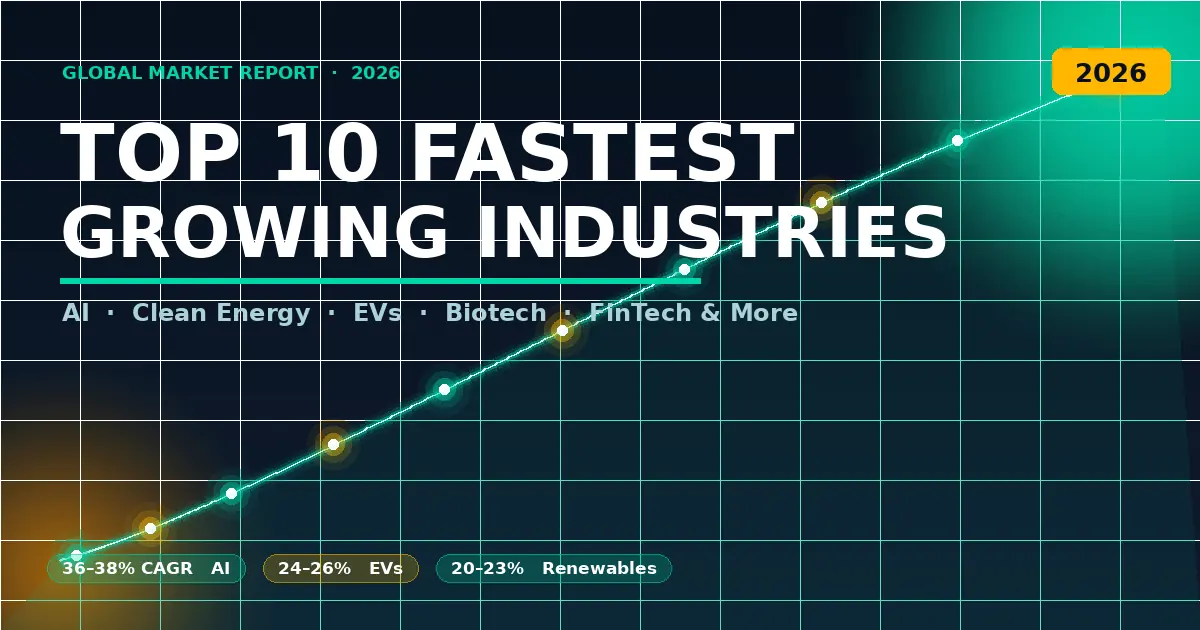
The AI industry is growing at an estimated 36–38% CAGR — making it the single fastest-expanding sector in the global economy. Global AI market revenue is expected to exceed $630 billion in 2026, up from roughly $196 billion in 2023. The driver isn’t just chatbots. It’s AI embedded in healthcare diagnostics, legal review, financial modeling, industrial automation, and drug discovery.
What’s accelerating growth in 2026 specifically: the shift from proof-of-concept to deployment. Enterprises that spent 2023–2024 experimenting are now running AI at scale. NVIDIA, Microsoft, Google, and hundreds of startups are benefiting from this transition.
Real signals: Saudi Arabia’s $40 billion AI infrastructure fund announced in 2025 with Andreessen Horowitz. The U.S. and EU both passed significant AI investment legislation. Enterprise AI software spending alone crossed $100 billion globally.
Opportunity: AI engineers, prompt engineers, AI auditors, and MLOps specialists are among the most in-demand professionals of 2026.
2. Renewable Energy & Clean Technology
Renewable energy is expanding at a 20–23% CAGR and is now the fastest-growing segment of the global energy sector. The International Energy Agency (IEA) reported that solar power alone added more new capacity in 2024 than all other energy sources combined — a streak that continued into 2026.
The clean tech sector in 2026 is not just solar panels. It includes green hydrogen production, battery storage systems, smart grid infrastructure, and carbon capture technology. Global clean energy investment crossed $1.8 trillion in 2024 (BloombergNEF), and 2026 is tracking higher.
Why 2026 is different: Government mandates have real teeth now. The U.S. Inflation Reduction Act, the EU’s Green Deal Industrial Plan, and China’s 14th Five-Year Plan are all driving compulsory transition spending — regardless of private sector sentiment.
Real signals: Utility-scale battery storage projects are being commissioned across Texas, Germany, and Australia at record pace. Offshore wind contracts in the UK and Taiwan set new procurement highs in 2025.
Opportunity: Roles in grid engineering, energy storage R&D, ESG compliance, and clean tech project finance are growing faster than the pipeline of qualified workers.
3. Cybersecurity
Cybersecurity is growing at approximately 13–15% CAGR and is projected to be a $345+ billion global industry by 2026. Every industry on this list — AI, fintech, EVs, healthcare — creates new attack surfaces. The more digital infrastructure expands, the more cybersecurity spending must follow.
In 2026, the threat landscape has shifted. AI-generated phishing, deepfake fraud, and ransomware-as-a-service have raised the stakes dramatically. Nation-state cyber attacks on critical infrastructure have prompted governments to mandate minimum cybersecurity standards for industries from banking to power grids.
Real signals: The U.S. Cybersecurity and Infrastructure Security Agency (CISA) reported a 72% increase in critical infrastructure attacks between 2022 and 2024. The EU’s NIS2 Directive, which came into force in 2024, created compliance spending across thousands of European companies.
Opportunity: Demand for cloud security architects, ethical hackers (penetration testers), AI security researchers, and compliance analysts is significantly outpacing supply. Entry-level certifications like CompTIA Security+ and CISSP remain direct paths into $80,000–$130,000+ starting roles.
4. Electric Vehicles & Clean Transportation
The EV and clean transport sector is expanding at a 24–26% CAGR globally, with the market expected to reach $1.3 trillion by 2026. Global EV sales crossed 17 million units in 2024 and are tracking higher in 2026, driven by price parity with combustion vehicles in key segments and aggressive government mandates in Europe, China, and parts of North America.
The growth isn’t just in passenger cars. Electric commercial vehicles — buses, delivery trucks, and last-mile vehicles — are the fastest-growing EV sub-segment in 2026. Companies like BYD, Tesla, Rivian, and dozens of regional manufacturers are scaling production at unprecedented rates.
Real signals: China accounted for roughly 60% of global EV sales in 2024. The EU’s 2035 combustion engine ban is reshaping every European auto manufacturer’s capital allocation. Charging infrastructure investment hit $30 billion globally in 2024.
Opportunity: Battery engineers, EV software developers, charging network operators, and supply chain specialists for lithium, cobalt, and nickel are in high demand.
5. Biotechnology & Precision Medicine
Biotech is growing at approximately 15–17% CAGR, with the global market projected to exceed $800 billion in 2026. The sector’s expansion is driven by mRNA vaccine platforms, CRISPR gene editing, personalized oncology treatments, and AI-accelerated drug discovery.
What changed the game: the COVID-19 pandemic proved mRNA technology at scale. Since 2021, pharmaceutical companies have redirected billions into mRNA-based therapies for cancer, HIV, and rare genetic diseases. In 2026, several mRNA cancer vaccines are in Phase 3 trials.
Real signals: Moderna’s oncology pipeline reached over 40 cancer vaccine candidates by 2025. DeepMind’s AlphaFold protein structure database is now used by virtually every major pharmaceutical R&D team, cutting drug discovery timelines from years to months.
Opportunity: Bioinformatics analysts, clinical trial coordinators, CRISPR researchers, and regulatory affairs specialists are among the fastest-growing roles in life sciences.
6. Semiconductor & Advanced Manufacturing
Semiconductors are growing at 12–14% CAGR, with the global market approaching $700 billion in 2026. After the supply chain crisis of 2021–2023 exposed dangerous concentration in chip manufacturing, the U.S., EU, Japan, South Korea, and India launched aggressive domestic production programs. The CHIPS Act (U.S.), the European Chips Act, and India Semiconductor Mission collectively represent over $200 billion in government investment.
AI is the primary demand driver. Training large language models and running inference at scale requires enormous quantities of advanced chips. NVIDIA’s data center GPU revenue — a proxy for AI infrastructure spending — grew over 200% in 2024.
Real signals: TSMC, Intel, Samsung, and Micron are all building new fabrication plants in regions that previously had little to no domestic chip production. Taiwan remains the leading manufacturer of cutting-edge chips, but geographic concentration risk is accelerating investment elsewhere.
Opportunity: Semiconductor process engineers, chip designers, fab technicians, and supply chain analysts are in critical shortage globally.
7. The Space Economy
The space economy is growing at 9–10% CAGR, but its absolute investment scale makes it one of the most watched sectors of 2026. Morgan Stanley projected the space economy would reach $1 trillion by 2040 — but the pace of investment suggests that timeline may compress. The 2026 market sits near $700 billion when commercial satellite services, launch vehicles, and government contracts are combined.
SpaceX’s Starlink alone serves over 4 million active subscribers globally. The real 2026 story is the commercial launch market — over a dozen private launch companies are now operational, driving launch costs down dramatically and opening space to industries that couldn’t afford it five years ago.
Real signals: Amazon’s Project Kuiper launched its first commercial satellites in 2024. NASA’s Artemis program and commercial lunar contracts are injecting capital into a new generation of aerospace startups.
Opportunity: Aerospace engineers, satellite communications specialists, space law experts, and on-orbit servicing technicians are emerging roles with strong long-term demand.
8. FinTech & Digital Payments
FinTech is growing at 19–21% CAGR globally, with the digital payments segment alone exceeding $12 trillion in transaction value in 2026. The sector includes neobanks, buy-now-pay-later (BNPL) platforms, cross-border payment infrastructure, embedded finance, and regulated stablecoin systems.
The 2026 story is financial infrastructure in emerging markets. In Southeast Asia, sub-Saharan Africa, and Latin America, mobile-first banking is leapfrogging traditional bank branches entirely. Over 1.4 billion previously unbanked adults now have access to digital financial services — creating one of the largest consumer expansions in history.
Real signals: India’s UPI system processed over 130 billion transactions in 2024. Brazil’s PIX instant payment network added 80 million new users in two years. Central bank digital currencies (CBDCs) are live in over 11 countries.
Opportunity: Blockchain developers, compliance officers for digital assets, embedded finance engineers, and financial crime analysts are in high demand across both startups and traditional banks.
9. E-commerce & Last-Mile Logistics
Global e-commerce is growing at 14–15% CAGR, with the market crossing $7 trillion in 2026. Growth is no longer concentrated in the U.S. and China. Southeast Asia, the Middle East, and Africa are the fastest-expanding e-commerce geographies, driven by smartphone penetration and improving logistics infrastructure.
The real innovation in 2026 is last-mile delivery. Autonomous delivery vehicles, drone delivery (now commercially operational in select markets), and AI-driven warehouse management are reshaping fulfillment economics. Same-day delivery has become table stakes for major platforms in urban markets.
Real signals: Shopify reported that over 50% of its merchants now use AI-powered tools for inventory, pricing, or customer service. Amazon’s drone delivery program, Prime Air, is operational in multiple U.S. cities. TikTok Shop’s growth disrupted both Meta and Google as discovery-to-purchase platforms.
Opportunity: Supply chain analysts, logistics technology developers, e-commerce performance marketers, and warehouse automation engineers are growth roles.
10. Mental Health & Digital Wellness Technology
The mental health and wellness tech industry is growing at 17–19% CAGR and is projected to exceed $140 billion globally in 2026. This sector includes digital therapy platforms, AI-assisted mental health tools, wearable mental wellness devices, corporate wellness programs, and app-based behavioral health services.
The demand driver is both clinical and cultural. Post-pandemic awareness of mental health needs combined with a significant shortage of licensed therapists has made digital mental health platforms a necessity, not a luxury. Employers are now mandating mental health benefits at scale.
Real signals: Headspace merged with Ginger to create one of the world’s largest mental health platforms. Spring Health raised at a $3.3 billion valuation in 2024. The FDA cleared several prescription digital therapeutics for mental health conditions, legitimizing the category.
Opportunity: Clinical psychologists who understand digital health, mental health app developers, UX researchers specializing in behavior change, and corporate wellness program managers are all in growing demand.
Industry Growth Rates Compared: At-a-Glance Data
| Industry | Est. 2026 Market Size | CAGR (2024–2030) | Key Driver |
|---|---|---|---|
| Artificial Intelligence & ML | $630B+ | 36–38% | Enterprise deployment at scale |
| Electric Vehicles | $1.3T | 24–26% | Policy mandates + price parity |
| FinTech & Digital Payments | $12T (transaction vol.) | 19–21% | Emerging market banking |
| Renewable Energy | $1.8T (investment) | 20–23% | Government mandates |
| Mental Health Tech | $140B | 17–19% | Therapist shortage + employer demand |
| Biotechnology | $800B | 15–17% | mRNA + AI-accelerated drug discovery |
| E-commerce & Logistics | $7T | 14–15% | Emerging market growth |
| Cybersecurity | $345B | 13–15% | AI threat surface expansion |
| Semiconductors | $700B | 12–14% | AI chip demand |
| Space Economy | $700B | 9–10% | Commercial launch + satellite services |
Sources: IEA, BloombergNEF, Gartner, Grand View Research, Morgan Stanley, IDC — 2024–2025 reports.
How to Actually Position Yourself in a Fast-Growing Industry
Knowing which industries are growing is step one. Translating that into a concrete move is step two. Here’s what works:
1. Identify your transferable skills first. Before chasing a hot sector, audit what you already know. A financial analyst can move into FinTech compliance faster than they can become a semiconductor engineer. The fastest path into a growth industry is usually lateral, not from scratch.
2. Target the supporting ecosystem, not just the headline jobs. Every major industry on this list needs legal professionals, marketers, project managers, HR teams, and operations specialists — not just engineers. The AI industry needs AI ethicists, policy writers, and sales engineers as urgently as it needs ML researchers.
3. Get certified, not necessarily degreed. In cybersecurity, renewable energy project finance, and FinTech, industry certifications from recognized bodies often carry more weight than a new degree. AWS, CompTIA, CFA Institute, and IRENA all offer programs that hiring managers specifically value.
4. Watch the funding, not the headlines. Crunchbase, PitchBook, and CB Insights publish weekly data on where venture capital and private equity are flowing. The sectors attracting the most funding today are where job demand will spike in 12–18 months.
5. Start building domain-specific knowledge now. Read the industry publications. Follow the regulatory bodies. Understand the supply chains. In fast-moving industries, people who understand context — not just skills — advance fastest.
Five Myths About Industry Growth (And the Reality)
Myth 1: “Fast growth means easy entry.” Reality: High-growth industries are also the most competitive. AI and biotech attract the best talent globally. Growth creates more jobs, not easier jobs.
Myth 2: “These industries will replace all existing jobs.” Reality: Automation reshapes job categories — it rarely eliminates them entirely. The EV transition is destroying some auto jobs while creating more in battery manufacturing, software, and charging infrastructure.
Myth 3: “Growth industries are immune to downturns.” Reality: FinTech saw brutal valuation cuts in 2022–2023 despite long-term growth fundamentals. High CAGR doesn’t mean linear, uninterrupted growth.
Myth 4: “You must be in Silicon Valley or Shenzhen to participate.” Reality: Remote work, global hiring, and distributed teams mean that top AI companies, FinTech startups, and biotech firms hire globally. Geography matters less than expertise.
Myth 5: “The window is already closed.” Reality: Each of these industries is in early-to-mid expansion phase. The semiconductor industry in 2026 is where the internet was in 1999. The mental health tech space is where telehealth was in 2018. Entry points still exist — especially for those building genuine expertise.
Frequently Asked Questions
What is the single fastest-growing industry in the world in 2026?
Artificial Intelligence and Machine Learning holds the highest CAGR of any major global sector in 2026, growing at approximately 36–38% annually. Fueled by enterprise adoption, government investment, and infrastructure spending, the AI market is expected to exceed $630 billion in revenue in 2026 alone.
Which fast-growing industries offer the most jobs?
Renewable energy, e-commerce and logistics, and cybersecurity are creating the highest volume of new jobs globally. Unlike AI or biotech, these sectors also have significant demand for skilled trade workers, technicians, and operational roles — not just highly specialized technical positions.
Is it too late to enter the EV industry in 2026?
No. The EV industry is still in early growth phase globally. Outside China and parts of Europe, EV adoption is accelerating, meaning the supply chain, infrastructure, and software ecosystems need workers urgently. Battery technology, fleet electrification, and charging software are particularly open to new entrants.
What industries are growing fastest in emerging markets specifically?
FinTech, e-commerce, renewable energy, and mobile health services are growing fastest in emerging markets including India, Nigeria, Indonesia, Brazil, and Vietnam. Digital infrastructure is leapfrogging legacy systems in these regions, creating outsized growth compared to mature economies.
How do I invest in these fast-growing industries?
Options include publicly traded companies (NVIDIA for AI chips, NextEra Energy for renewables, CrowdStrike for cybersecurity), sector-specific ETFs (e.g., ARKQ for AI/robotics, ICLN for clean energy), or venture exposure through equity crowdfunding platforms. Each carries different risk profiles — consult a financial advisor for personal investment decisions.
Which fast-growing industry pays the highest salaries in 2026?
AI/ML engineering, semiconductor design, and biotechnology research offer the highest median compensation. AI researchers at top companies can earn $300,000–$500,000+ in total compensation. Cybersecurity architects and FinTech quant developers also command $150,000–$250,000+ in major markets.
Are these growth trends global or concentrated in specific countries?
Both. AI, cybersecurity, and FinTech are genuinely global. Renewable energy growth is concentrated in China, the U.S., EU, and India. The space economy is led by the U.S. and increasingly China. However, talent, investment, and opportunity in every sector are more internationally distributed in 2026 than they were five years ago.
Conclusion
The ten industries covered here — AI, renewable energy, cybersecurity, EVs, biotech, semiconductors, space, FinTech, e-commerce, and mental health tech — share one thing: they’re all solving problems the world has no option but to address. Energy transition, digital security, health access, and financial inclusion aren’t optional priorities. That structural necessity is what makes their growth durable, not just trendy.
The clearest action step from this analysis: pick one industry that aligns with your existing skills or genuine interest, go one level deeper than general awareness, and start building domain knowledge today. The difference between people who benefit from these waves and those who watch them pass is almost always how early they committed to understanding a sector.
Every major shift creates a decade of opportunity for those who show up prepared.
Explore fresh content that brings value—start reading and pull ahead with steady learning.