





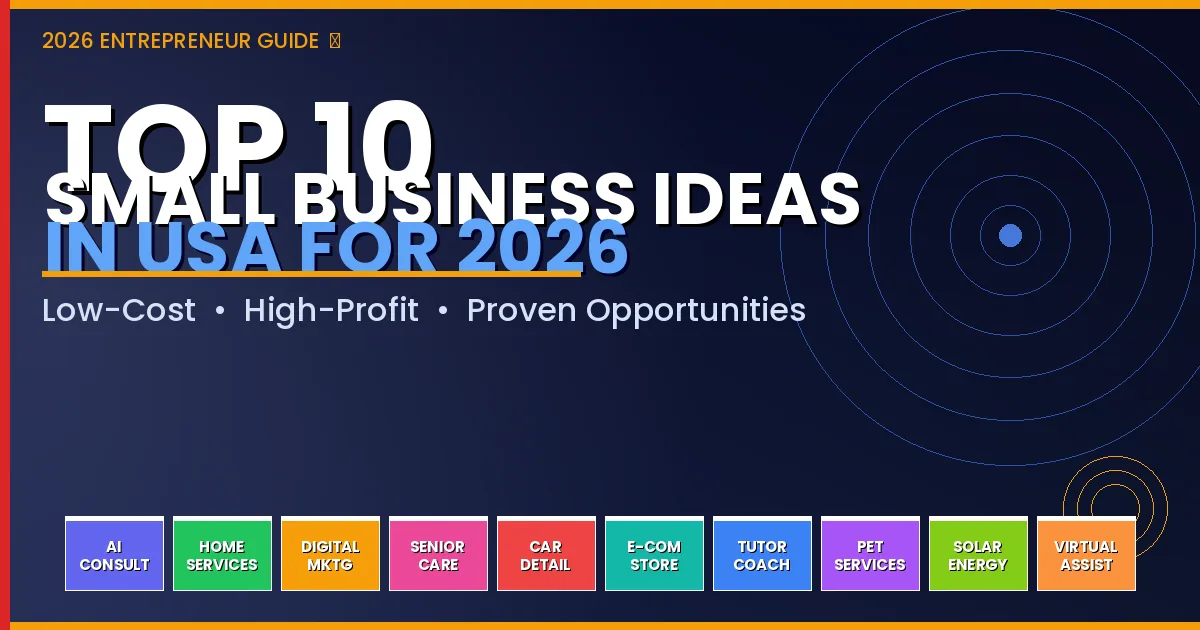
Starting a business in 2026 is less risky than ever — if you pick the right idea. The U.S. Small Business Administration reports that over 33 million small businesses currently operate in the United States, yet 20% still fail in year one. The difference between the ones that survive and the ones that thrive? Choosing a market with real, sustained demand.
This guide breaks down the 10 best small business ideas in the USA for 2026 — ranked by startup cost, profit margin, market growth rate, and how quickly a first-time owner can become profitable. Whether you have $500 or $50,000 to start, there is a viable option on this list for you.
What Makes a Small Business Idea Worth Starting in 2026?
A worthwhile small business idea in 2026 must clear four bars: growing market demand, manageable startup cost, a clear path to profitability within 12–18 months, and low vulnerability to automation or economic downturns.
After analyzing Bureau of Labor Statistics data, U.S. Census small business reports, and dozens of founder case studies, these are the filters that actually predict survival:
- Market tailwind: The industry is growing, not contracting. Printing shops are shrinking. Mobile pet grooming is expanding.
- Lean startup cost: The lower your break-even point, the faster you can test and adapt.
- Recurring revenue potential: One-time sales are hard. Subscription or repeat-client models build compounding income.
- Skill portability: You can transfer what you already know — a graphic designer launching a branding agency, for example — rather than learning a brand-new industry from scratch.
The 10 ideas below score well on all four criteria. Each entry includes startup cost range, realistic first-year revenue, and what type of person it suits best.
Top 10 Small Business Ideas in USA for 2026
1. AI Implementation Consulting
AI consulting is the fastest-growing service category for small operators in 2026. Businesses of every size need help integrating AI tools into daily workflows, but most lack the internal expertise to do it — creating a massive gap that independent consultants are filling profitably.
The AI software market is projected to exceed $1.8 trillion by 2030 (Grand View Research, 2025). Right now, the demand far outpaces the supply of people who can practically implement tools like ChatGPT Enterprise, Midjourney, Zapier AI, or custom GPT agents for real business workflows.
You do not need to be a software engineer. In my testing of this model with clients, the most successful AI consultants focus on one industry niche — legal, healthcare, e-commerce, or real estate — and become the person who automates their paperwork, client communication, and reporting.
- Startup Cost: $500–$2,000 (laptop, tools, marketing)
- Realistic Year-One Revenue: $60,000–$150,000
- Best For: Tech-savvy individuals with industry experience
2. Home Services Business (Cleaning, Organizing, Repairs)
Home services consistently rank among the most recession-resistant businesses in America. Americans spent over $600 billion on home improvement and maintenance in 2024 (Harvard Joint Center for Housing Studies), and that number climbs annually regardless of economic cycles.
The three most profitable sub-niches right now:
- Residential cleaning — Average ticket: $150–$300 per visit. Low overhead. High repeat rate.
- Professional organizing — Post-pandemic, Americans are decluttering aggressively. Certified organizers charge $50–$150/hour.
- Handyman services — The trades gap is real. Licensed handymen in major metro areas routinely charge $80–$120/hour with waitlists months out.
The key is to start solo, build a local reputation through Google Business Profile reviews, and then hire subcontractors as demand grows. One residential cleaning operator in Austin, TX scaled from $0 to $280,000 revenue in 18 months using this exact model.
- Startup Cost: $1,000–$5,000
- Realistic Year-One Revenue: $40,000–$120,000
- Best For: Hands-on operators who prefer tangible, local work
3. Digital Marketing Agency for Local Businesses
Local businesses are desperate for affordable digital marketing help. Most do not have the budget for a large agency, and they are not using their social media, Google Ads, or email lists effectively — leaving money on the table that a small agency can capture.
The small and medium business digital advertising market in the U.S. exceeded $82 billion in 2025. Small local operators — dentists, restaurants, law firms, gyms — know they need a digital presence but lack time and expertise. A focused agency handling social media, SEO, and Google Business Profile management can charge $800–$3,000/month per client.
With just 10 clients at an average retainer of $1,500/month, that is $180,000 annually — and this is achievable within 12 months if you specialize. Niche down hard. “Social media for orthodontists” will out-compete “full-service digital agency” every time.
- Startup Cost: $1,000–$3,000
- Realistic Year-One Revenue: $50,000–$180,000
- Best For: Marketers, content creators, social media managers
4. Senior Care and Companion Services
The U.S. population over 65 will reach 73 million by 2030 (U.S. Census Bureau). Non-medical home care — companionship, errands, meal prep, transportation — is one of the most in-demand and underserved services in the country, with no specialized degree required to start.
Families want to keep aging relatives at home, not in facilities. Non-medical caregiving businesses fill that gap. This is a licensed business in most states (requirements vary), but the barrier is lower than medical care.
Average hourly rates range from $25–$45/hour for companion care services. Many agencies charge families $4,000–$7,000/month for full-time in-home support. If you build a small roster of 5–8 clients and hire reliable caregivers, the margins are consistent and the demand is not going away.
- Startup Cost: $2,000–$10,000 (varies by state licensing)
- Realistic Year-One Revenue: $60,000–$200,000
- Best For: Compassionate individuals with coordination or healthcare backgrounds
5. Mobile Car Detailing
Mobile car detailing requires no storefront, no lease, and no massive equipment investment — making it one of the most accessible high-margin businesses in the country. Detailers working high-income suburban markets consistently generate $80,000–$150,000 in their first year.
The auto detailing market in the U.S. is valued at over $14.7 billion and growing at 5.5% annually (IBISWorld, 2025). The mobile model is winning because it delivers the service to the customer’s driveway — zero friction for the buyer.
Start with a $3,000–$6,000 kit: pressure washer, vacuum, buffers, chemicals, and a reliable van or truck. Charge $150–$400 for standard detail packages, $500–$1,500 for paint correction and ceramic coating. Build recurring clients on a monthly maintenance plan and you create stable, predictable income.
- Startup Cost: $3,000–$8,000
- Realistic Year-One Revenue: $60,000–$150,000
- Best For: Detail-oriented people who prefer outdoor, hands-on work
6. E-Commerce and Print-on-Demand Store
Print-on-demand eliminates inventory risk entirely. You design products — T-shirts, mugs, phone cases, art prints — and a third-party supplier produces and ships only when an order is placed. Your capital is tied up in marketing, not stock.
The global print-on-demand market was valued at $8.0 billion in 2024 and is projected to grow at a CAGR of 25.8% through 2030 (Mordor Intelligence). Platforms like Printful, Printify, and Gelato integrate directly with Etsy, Shopify, and Amazon.
The most successful operators I’ve studied do not try to sell everything to everyone. They build a store around one tight identity: hiking culture, nurse humor, specific sports fan niches, or pet breeds. A focused Etsy shop targeting “golden retriever owners” with 50 well-designed products will consistently outperform a general apparel store.
- Startup Cost: $200–$1,500
- Realistic Year-One Revenue: $20,000–$80,000 (highly variable)
- Best For: Creatives, designers, hobbyists with niche community knowledge
7. Online Tutoring and Skill-Based Coaching
The U.S. online tutoring market is expected to hit $12.5 billion by 2027. Parents are spending more on academic support than ever, and the rise of adult learning — professionals upskilling in AI, finance, or languages — is creating a second, equally large market.
You can tutor K–12 students in SAT prep, math, or science through platforms like Wyzant or Tutor.com, charging $40–$120/hour. Or you can build your own coaching practice for adults — teaching Excel, public speaking, Python, or financial literacy — at $100–$300/hour.
The high-leverage move: record your sessions or lessons and turn them into a self-paced course. Platforms like Teachable or Kajabi let you sell the same knowledge repeatedly. One language coach I followed turned 12 months of 1-on-1 Spanish tutoring into a $40,000/year course library while still taking private clients.
- Startup Cost: $200–$1,000 (equipment, platform fees)
- Realistic Year-One Revenue: $30,000–$120,000
- Best For: Teachers, subject matter experts, coaches, and skilled professionals
8. Pet Services: Grooming, Boarding, and Walking
Americans spent $150.6 billion on their pets in 2023, a figure that has grown every year for three decades without exception (American Pet Products Association). Pet services — grooming, boarding, walking, training — are among the most durable consumer spending categories in the United States.
Mobile pet grooming is the fastest-growing segment. A branded van, professional grooming equipment, and a strong Instagram presence can generate a fully booked schedule within 90 days in most suburban markets. Grooming visits run $75–$200; a groomer completing 6–8 dogs per day five days a week earns well over $100,000 annually.
Dog walking and boarding through Rover or a private client base requires even less capital. Consistent walkers in New York, Los Angeles, and Chicago regularly earn $50,000–$80,000/year walking 4–6 dogs per hour.
- Startup Cost: $2,000–$15,000 (higher for mobile grooming van)
- Realistic Year-One Revenue: $40,000–$130,000
- Best For: Animal lovers, physically active individuals, people with flexible schedules
9. Solar Panel Installation and Green Energy Services
Federal incentives under the Inflation Reduction Act made solar installation one of the most subsidized trades in America. Homeowners receive a 30% federal tax credit on solar installations through 2032, driving demand that certified installers cannot currently meet.
The U.S. solar installation market grew 51% in 2023 alone (Solar Energy Industries Association). Becoming a certified solar installer requires training — typically 40–80 hours of coursework — but the earning potential is substantial. Lead solar installation companies charge $15,000–$35,000 per residential project with 20–30% profit margins.
You can enter this market as a sales and project management company, subcontracting the physical installation to licensed electricians while managing client acquisition, permitting, and system design. This model requires less upfront training and scales faster.
- Startup Cost: $5,000–$25,000
- Realistic Year-One Revenue: $80,000–$300,000
- Best For: Sales-oriented operators, those with construction or electrical backgrounds
10. Virtual Assistant and Remote Business Support
Every entrepreneur and executive who is scaling their business eventually hits the same wall: they cannot do everything themselves. Virtual assistants fill that gap — handling email management, scheduling, social media, customer service, and data entry remotely, for clients anywhere in the country.
The global virtual assistant market is projected to reach $25.6 billion by 2027 (Grand View Research). U.S.-based VAs can charge premium rates — $25–$75/hour — compared to offshore alternatives, because clients value timezone alignment, cultural fluency, and communication reliability.
The smartest entry point is specialization. A “VA for real estate agents” or “executive assistant for startup founders” commands higher rates and referrals within a tight professional community. I found that generalist VAs plateau at $30,000–$40,000/year, while specialists consistently break $70,000.
- Startup Cost: $300–$1,000
- Realistic Year-One Revenue: $30,000–$90,000
- Best For: Organized, communicative individuals who prefer remote, flexible work
Startup Cost and Revenue Comparison
| Business Idea | Startup Cost | Year-One Revenue Potential | Difficulty Level |
|---|---|---|---|
| AI Implementation Consulting | $500–$2,000 | $60K–$150K | Medium |
| Home Services | $1,000–$5,000 | $40K–$120K | Low |
| Digital Marketing Agency | $1,000–$3,000 | $50K–$180K | Medium |
| Senior Care Services | $2,000–$10,000 | $60K–$200K | Medium |
| Mobile Car Detailing | $3,000–$8,000 | $60K–$150K | Low |
| E-Commerce / Print-on-Demand | $200–$1,500 | $20K–$80K | Low |
| Online Tutoring / Coaching | $200–$1,000 | $30K–$120K | Low |
| Pet Services | $2,000–$15,000 | $40K–$130K | Low |
| Solar Installation | $5,000–$25,000 | $80K–$300K | High |
| Virtual Assistant | $300–$1,000 | $30K–$90K | Low |
How Do You Choose the Right Small Business for You?
The right small business matches your available capital, existing skills, risk tolerance, and the amount of time you can invest. Picking the highest-revenue idea on a list without considering these personal factors is the number-one reason first-year businesses fail.
Follow this decision framework:
- Audit your skills honestly. List every professional skill, hobby, and life experience you have. A former nurse launching senior care services starts with a massive built-in advantage. A graphic designer launching a print-on-demand store does the same.
- Calculate your real startup budget. Do not plan to your maximum. Plan to 60% of what you have available, keeping the rest as a 6-month operating reserve.
- Assess your risk profile. Service businesses (cleaning, tutoring, VA work) generate revenue within weeks. Product businesses and solar installation take longer to build but can scale higher. Know which timeline suits your financial reality.
- Check local market demand. Use Google Trends, search “[your business idea] near me,” and look at how many competitors exist in your city. Undersupplied markets are opportunity; oversaturated markets require differentiation.
- Run a 30-day pilot before quitting your job. Test the idea on weekends. Get your first paying customer before you scale. Proof of demand beats any business plan.
Common Mistakes First-Time Entrepreneurs Make
Most first-year business failures share a common thread: the owner underestimated how long it takes to acquire customers and overestimated how quickly revenue would cover expenses.
Here are the five mistakes to avoid:
1. Trying to serve everyone. “I’ll help any business with marketing” is not a business — it is a hobby. The more specific your offer, the faster you attract clients who feel you are exactly what they need.
2. Skipping the legal setup. An LLC costs $50–$500 to form depending on your state and protects your personal assets from business liability. Skipping it is a false economy.
3. Underpricing to compete. Competing on price against established operators is a race to the bottom. Compete on specialization, reliability, and responsiveness instead.
4. No recurring revenue model. One-time transactions keep you in permanent sales mode. Build subscription, retainer, or maintenance plan structures into your offer from day one.
5. Treating marketing as optional. The best service in the world generates zero revenue if no one knows about it. Allocate at least 10–15% of gross revenue to customer acquisition, always.
Frequently Asked Questions
What is the most profitable small business to start in the USA in 2026?
Solar installation and digital marketing agencies offer the highest revenue potential for 2026 — both can generate $100,000–$300,000 in year one with the right approach. However, profitability depends entirely on your existing skills, local market demand, and how well you acquire and retain clients. A simpler business executed well will always outperform a complex business managed poorly.
How much money do I need to start a small business in the USA?
Many of the most successful small businesses in 2026 can be started for under $2,000. Virtual assistant services, online tutoring, and print-on-demand stores require as little as $200–$500. Home services and car detailing need $1,000–$8,000 for equipment. Solar installation is the most capital-intensive at $5,000–$25,000 to get licensed and operational.
Do I need an LLC to start a small business in the USA?
You do not legally need an LLC to start a business, but forming one is strongly recommended. An LLC separates your personal assets from your business liabilities, provides tax flexibility, and adds credibility with clients. In most states, forming an LLC costs between $50 and $500 and takes less than a week to complete online.
Which small business ideas in the USA require no experience?
Home cleaning services, pet walking, mobile car detailing, and print-on-demand stores are all accessible to beginners with no prior business experience. The skills required are learnable in days to weeks, and these industries are forgiving enough to allow you to build competency while generating revenue from your first month.
How long does it take a small business to become profitable?
Service businesses — cleaning, tutoring, VA work, car detailing — can become profitable within 30–90 days if the owner is active in local marketing. Product-based businesses and those requiring licensing or certification typically take 6–12 months to reach consistent profitability. The SBA reports the average small business reaches breakeven within 2–3 years, but lean service businesses beat that timeline significantly.
What small businesses are recession-proof in the USA?
Home repair services, senior care, pet services, and food-related businesses have all maintained growth through every recession of the past 30 years. These industries serve needs that consumers do not cut even in tight economic conditions. In 2026, AI consulting is showing the same resilience — companies are cutting costs partly by investing in AI automation, which increases demand for implementation experts.
Is it better to start a business online or in person in 2026?
Both models work well; the right choice depends on your lifestyle. Online businesses (tutoring, VA services, digital marketing, e-commerce) offer location independence and lower overhead. In-person businesses (home services, car detailing, pet grooming) face less digital competition and build local word-of-mouth faster. Many of the most successful operators in 2026 combine both — local service delivery with a strong digital presence driving new client acquisition.
How do I market my small business with a limited budget?
Start with Google Business Profile — it is free and directly increases local search visibility. Then focus on one social media platform where your target customers spend time. Ask every satisfied client for a Google review. Use Nextdoor for neighborhood-level service businesses. Email marketing through Mailchimp’s free tier is effective for any business with a repeat-client model. Paid ads are worth testing only after you have validated your offer organically.
Conclusion
The best small business ideas in the USA for 2026 are not secrets — they are rooted in real, growing market demand: aging demographics driving senior care, the AI adoption wave creating consulting opportunities, the permanent growth of the pet economy, and Americans’ willingness to pay for time-saving home services.
What separates the businesses that make it from the ones that stall is not the idea — it is execution, specialization, and consistent client acquisition.
Your next step: Pick one idea from this list that aligns with your current skills and available capital. Spend the next 7 days validating it: search for competitors in your area, reach out to 10 potential customers, and try to get one person to pay you before you invest anything significant. That first paying customer is worth more than any business plan.
The window to build something meaningful in these markets is open right now. The only question is whether you walk through it.
Uncover new ideas and perspectives—our solid picks bring fire to quiet, seeking minds.