
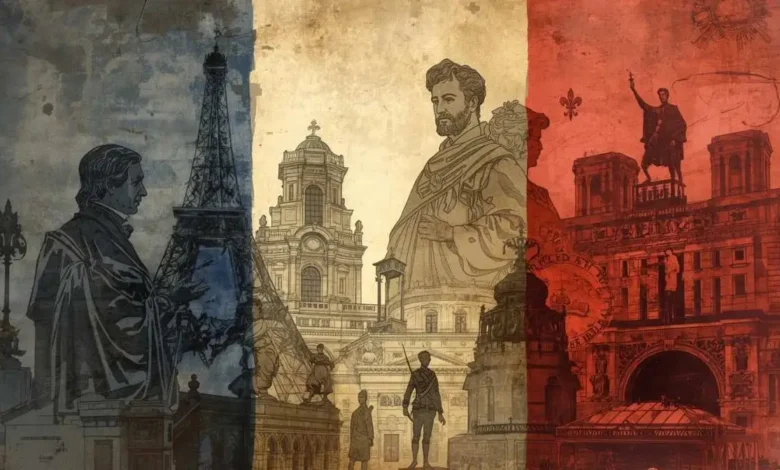
France, a country that has profoundly influenced the course of European and global history, has a rich and complex past that spans over two millennia. The story of France is one of cultural achievements, political upheavals, revolutions, and the rise and fall of empires. From the Celtic tribes that first inhabited the region to its modern-day status as a global power, France has undergone remarkable transformations. This article offers an in-depth exploration of France’s history, delving into key events, figures, and movements that have shaped the nation.
The Early History of France: The Gauls and Roman Influence
The roots of modern France can be traced back to ancient times when the region was inhabited by the Gauls, a Celtic people. The Gauls were divided into numerous tribes and lived in a society that prized warrior culture and personal freedom. They were skilled metalworkers, farmers, and traders, and their influence spread across much of Europe.
Roman Conquest: The Transformation of Gaul
In the 1st century BC, the region of Gaul fell under the control of the Roman Empire. Julius Caesar’s conquest of Gaul from 58–50 BC was one of the most pivotal moments in French history, as it led to the region’s incorporation into the Roman world. The conquest was not without resistance, but it marked the beginning of the end for the independent Gaulish tribes.
Roman rule brought significant changes to the region. The Romans established cities, built roads, and introduced Roman law, culture, and infrastructure. Gaul was transformed into a Roman province known as Gallia. The Romans also introduced agriculture, urbanization, and public works, laying the foundations for the development of the future French state.
The Gaulish Legacy and Romanization
Although the Romans ruled over Gaul for centuries, the region’s indigenous people retained many of their cultural traditions, which would later blend with Roman influences. The Romans built extensive road networks and aqueducts, some of which are still visible in modern France today. Cities such as Lyon (then called Lugdunum) became prominent centers of trade and culture. Roman influence also spread to the language, and Latin became the dominant language in Gaul, eventually evolving into the French language.
The Rise of the Franks: The Birth of Medieval France
After the fall of the Western Roman Empire in the 5th century, Gaul was invaded by a series of Germanic tribes, including the Visigoths, Burgundians, and Franks. Among these tribes, the Franks emerged as the most powerful. They established the foundations of modern France, with Clovis I being the first king to unite much of the Frankish territories.
Clovis and the Christianization of France
Clovis I, the king of the Franks, played a key role in shaping early French history. Clovis’s conversion to Christianity around 496 AD was a turning point in French history. After a significant victory in battle, he and his warriors were baptized by Saint Remigius, and this event marked the beginning of France’s close relationship with the Catholic Church.
Clovis’s conversion laid the foundation for the Christianization of France, and his dynasty, the Merovingians, ruled over much of modern-day France for several centuries. The Franks’ conversion also helped to establish France as a stronghold of Catholicism in Europe, influencing not only the religion of the region but also the future political landscape of the country.
The Carolingian Empire: Charlemagne’s Expansion
In the 8th century, the Carolingian dynasty, led by Charles Martel and later Charlemagne, became a dominant force in European politics. Charlemagne, crowned Emperor of the Holy Roman Empire in 800 AD by Pope Leo III, expanded the Frankish Empire to include much of Western Europe, including modern-day France, Germany, and parts of Italy.
Charlemagne’s reign marked the height of the Carolingian Empire, and he became known for his support of the arts, education, and the church. His rule set the stage for the later rise of France as a powerful European kingdom. However, after Charlemagne’s death in 814, the empire was divided among his heirs, leading to a gradual decline in central authority and the fragmentation of the empire.
The Capetian Dynasty: Foundation of the French Kingdom
The Capetian dynasty, founded by Hugh Capet in 987 AD, is often considered the true beginning of medieval France as a unified kingdom. Hugh Capet’s coronation marked the end of the Carolingian dynasty and the start of a new era in French history. Though early Capetian kings held limited power, the dynasty gradually consolidated control over the French territories.
The Strengthening of the French Monarchy
Throughout the Middle Ages, the French monarchy continued to grow in power. Kings such as Louis IX (Saint Louis), who reigned from 1226 to 1270, worked to centralize government and reform the legal system. Louis IX is remembered for his piety, leadership, and commitment to justice. His reign also saw the construction of great Gothic cathedrals like the Sainte-Chapelle in Paris, which exemplified the grandeur of medieval French architecture.
By the 14th century, however, France was drawn into one of the most significant conflicts in European history—the Hundred Years’ War.
The Hundred Years’ War: Struggles for Power and French Identity
The Hundred Years’ War (1337–1453) was a series of conflicts between France and England, primarily over territorial disputes and claims to the French throne. The war was sparked by Edward III of England’s claim to the French crown and escalated into a full-scale conflict that would last over a century.
Joan of Arc: A National Heroine
One of the most significant figures to emerge during the war was Joan of Arc. Born into a peasant family, Joan claimed to have received divine visions instructing her to help Charles VII reclaim his throne. She played a crucial role in the French victory at the Siege of Orléans in 1429, boosting French morale and securing Charles VII’s coronation as king.
Joan was captured by the English, tried for heresy, and executed by burning at the stake in 1431. However, her legacy as a symbol of French unity and resistance against foreign invasion endures to this day. She was canonized as a saint by the Catholic Church in 1920.
The End of the Hundred Years’ War
The Hundred Years’ War ended in 1453 with the Treaty of Picquigny, which resulted in the expulsion of the English from most of France. The war played a critical role in shaping French national identity and solidifying the power of the monarchy.
The Renaissance and Religious Wars in France
The 16th century was a time of both cultural flourishing and religious conflict in France. The French Renaissance, fueled by the influx of Italian Renaissance ideas and the patronage of King Francis I, brought significant advancements in art, science, and architecture.
The French Wars of Religion
However, this period was also marked by religious strife. The Protestant Reformation, which had begun in Germany with Martin Luther, spread to France and led to the rise of the Huguenots (French Protestants). This sparked a series of religious wars between Catholics and Huguenots, which lasted from 1562 to 1598.
The most infamous event of these wars was the St. Bartholomew’s Day Massacre in 1572, during which thousands of Huguenots were killed by Catholic mobs. The wars finally came to an end with the Edict of Nantes in 1598, issued by King Henry IV. The edict granted religious freedom to Protestants and helped bring an end to the religious conflicts that had plagued France for decades.
The French Revolution: The Overthrow of the Monarchy
The late 18th century saw the rise of revolutionary sentiment in France, spurred by widespread economic hardship, inequality, and Enlightenment ideas. The French Revolution, which began in 1789, was one of the most significant events in world history and completely transformed France.
The Fall of the Monarchy
In 1789, the storming of the Bastille, a symbol of royal tyranny, marked the beginning of the revolution. The National Assembly, formed by the representatives of the common people, demanded the end of the monarchy and the establishment of a constitutional government. King Louis XVI and Queen Marie Antoinette were eventually executed by guillotine, and the monarchy was abolished.
The Reign of Terror and Napoleon
The revolution led to the rise of radical leaders such as Maximilien Robespierre, who initiated the Reign of Terror (1793–1794), a period of mass executions of perceived enemies of the revolution. The violence and instability of the revolution ultimately paved the way for the rise of Napoleon Bonaparte, who seized control of France in 1799 and declared himself Emperor in 1804.
Napoleon Bonaparte: The Rise of an Empire
Napoleon Bonaparte, one of the most famous military leaders in history, rose to power during the latter stages of the French Revolution. His military genius and the popularity of his reforms allowed him to consolidate power quickly.
Napoleon’s Empire and Decline
Napoleon expanded the French Empire across much of Europe through a series of military campaigns known as the Napoleonic Wars. However, his aggressive expansionism eventually led to his downfall. The disastrous invasion of Russia in 1812 weakened Napoleon’s forces, and by 1814, he was defeated and exiled to the island of Elba. Though he briefly returned to power during the Hundred Days in 1815, he was defeated at the Battle of Waterloo and exiled to Saint Helena, where he died in 1821.
Modern France: From Revolution to Republic
Following Napoleon’s defeat, the Bourbon monarchy was restored, but France remained politically unstable, experiencing multiple revolutions throughout the 19th century. The Third Republic was established in 1870 after the defeat of Napoleon III in the Franco-Prussian War. This period saw France undergo industrialization, urbanization, and the expansion of its colonial empire.
World War I and World War II
France was heavily affected by both World War I and World War II. In World War I, France suffered massive losses in the trenches, and the war’s aftermath left the country economically weakened. World War II saw France occupied by Nazi Germany, and the Vichy regime, led by Marshal Philippe Pétain, collaborated with the Nazis. The French Resistance, led by figures like Charles de Gaulle, played a crucial role in the liberation of France in 1944.
The Fifth Republic and Modern France
In 1958, Charles de Gaulle founded the Fifth Republic, a more stable and enduring form of government. Under de Gaulle’s leadership, France rebuilt itself after the war, becoming a leading European power and a founding member of the European Union. Today, France is a republic with a strong economy, a key role in international politics, and a rich cultural heritage that continues to influence the world.
Conclusion: The Enduring Influence of France
The history of France is a story of transformation, from ancient tribal societies to a powerful monarchy, revolution, and empire. Throughout its history, France has shaped and been shaped by the ideas, events, and movements that have shaped Europe and the world. Its legacy, particularly in art, philosophy, politics, and culture, continues to influence the world today. Understanding the history of France offers valuable insights into the country’s global significance and its enduring contributions to human progress.
FOR MORE INTERESTED BLOGS PLAESE VISIT OUR WEBSITE